
The original Profumo
The (other) scandal everyone is talking about
If there is one word being used almost as much as Mandelson this week it’s Profumo, although having written about the latter in my book I’ve always been sceptical it was as big a scandal as its place in the national psyche. You can read for yourself below, but the evidence that actual secrets were shared is thin to non-existent, unlike the apparent contents of Peter Mandelson’s emails. I’ll be back over the weekend with a regular What We Learned This Week.
Swimming pool, Cliveden
Saturday, 8 July 1961
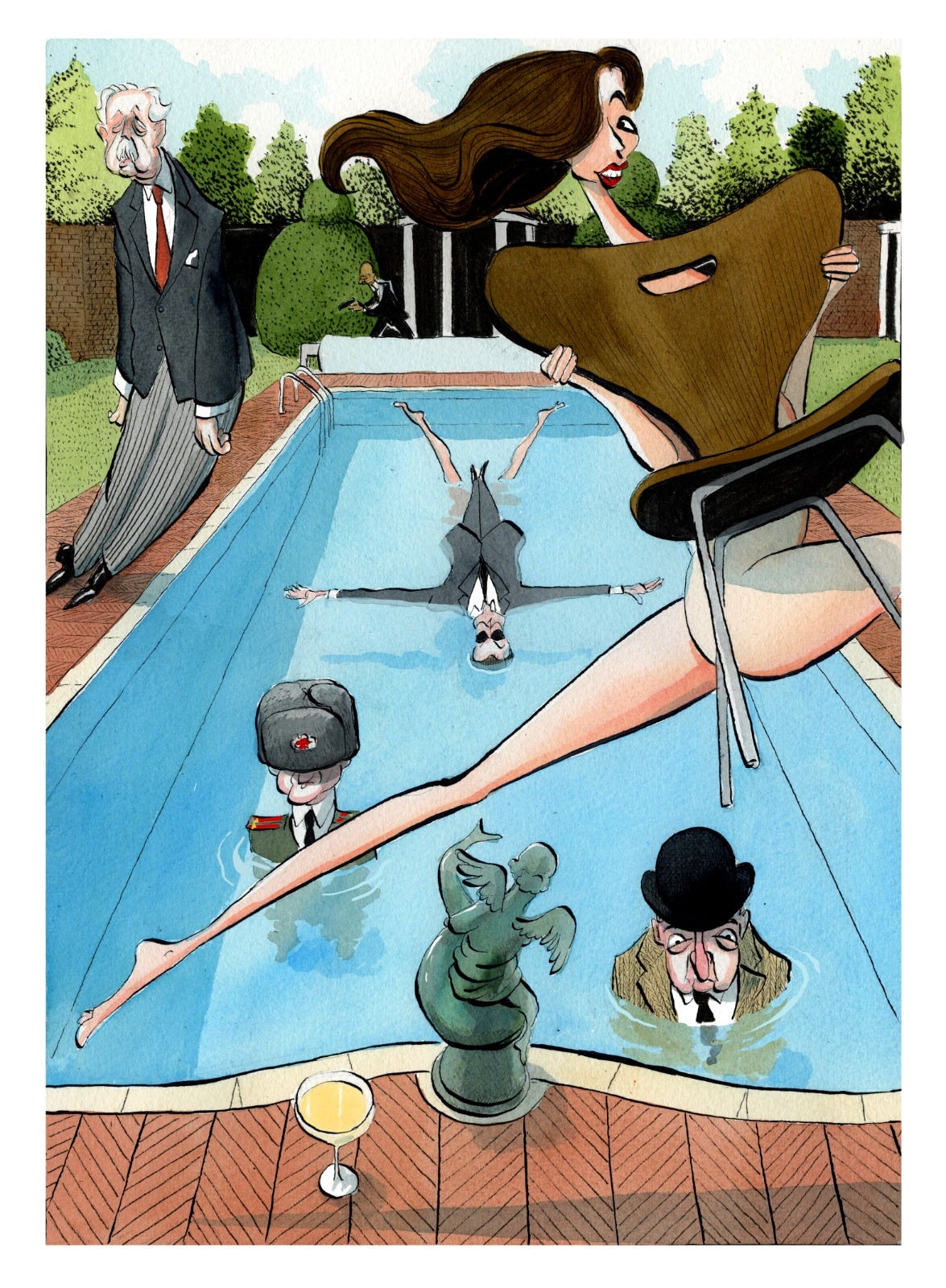
Even on a cold spring evening, perhaps especially so, the water is delightful. Steam gently rises from the shallow waves. Outdoor pools are just better. None of the stuffy heat and chlorine and noise that you get indoors. And this is a long way from the plasters and hair and screaming that make public swimming baths so awful.
Sploshing about in the most famous pool in politics, surrounded by the high garden walls, gazing up at the ornate water tower installed after the manor house burnt down for the second time in the nineteenth century, it is impossible not to feel the sense of history. Climbing out of the pool to make use of the hot tubs, it is impossible not to feel the cold. It was a much warmer summer’s evening in 1961 when Christine Keeler, a 19-year-old model and girl about town, left wet footprints on these same herringboned red-brick tiles. She was dashing to grab a towel, just as a group from the big house arrived to change her life.
Keeler had an unfortunate start. Her father abandoned the family when she was young. Her mother set up home with another man, living in a converted railway carriage at Wraysbury in Berkshire, without electricity or hot water. After leaving school without any qualifications, she moved to London aged 15. It was while working at Murray’s Cabaret Club in Soho that she met Stephen Ward, a slightly dubious osteopath to the stars, and Mandy Rice-Davies, a showgirl from Wales. The two young women moved into Ward’s house in Marylebone, and the partying went up a notch.
Lord Astor liked a party too. The third viscount, the eldest son of Nancy Astor, who was the first woman to take her seat in the Commons, was one of Ward’s high-society patients. A former Conservative MP, he was a ministerial bag carrier in Chamberlain’s 1930s government, served as a naval intelligence officer in the Second World War, and had to give up the Commons when he inherited the peerage from his father in 1952. Having suffered an injury after falling while hunting, he did what anyone with a bad back would do and gave his osteopath the use of a cottage in the grounds of his stately home in the Berkshire countryside. Spring Cottage was a nice quiet spot, and long before Ward moved in had previously been used by the Duchess of Sutherland to entertain Queen Victoria.
Two worlds – of stiff-upper-lipped English aristocracy and the sexually-charged sixties – would collide one July weekend in 1961. Ward had invited friends to the cottage for a party, including Keeler and Yevgeny Ivanov, a Soviet naval attaché and spy. A mile away, Astor also had friends to stay. Among the first to arrive were John Profumo, the suave secretary of state for war in Macmillan’s Conservative government, and his wife, Valerie Hobson, a 1940s film actress. Among the other two dozen guests on the Saturday night were Nubar Gulbenkian, a flamboyant Armenian tycoon and socialite who travelled in a custom-made gold‐plated taxi, and Lord Mountbatten, the war hero and uncle of Prince Phillip.

The story of what happened next is as famous as it is famously unreliable. The problem with a saga of sex and lies is that everyone involved lies about everything, including the sex. Lies in the papers, lies in the courtroom, lies in the Commons.
So Ward and Keeler were in the pool. Or maybe just Keeler, who was skinny-dipping. Or was wearing a costume, but it was too big and falling off. Or it had been taken and hidden by Ward. At around 10.30 p.m. Astor and his guests, in dinner suits and evening gowns, left Cliveden House for a stroll. To take in the evening air. Or perhaps to admire the small bronze statue of Astor’s son riding a dolphin which had recently been installed at the pool edge at the deep end of the pool. In politics, as in life, timing is everything. And just as Profumo walked into the walled garden he caught a glimpse of Keeler, naked. Someone, possibly Valerie Profumo, helped Keeler find a towel. Astor said that nothing more happened that night. When Keeler sold her story eighteen months later she claimed Astor and Profumo had chased her naked around the pool.
On Sunday the president of Pakistan, General Ayub Khan, joined the guests for lunch. Keeler claimed in the papers that there were more pool-based frolics: the men with a girl each on their shoulders, trying to wrestle their opponents into the water. Keeler was on Profumo’s shoulders. Or maybe not. At some point Profumo acquired Keeler’s telephone number, and an affair ensued. Then there was also Ivanov, who drove her back to London and went to bed with her. She was sleeping with a Russian spy and a government minister at the same time. Or actually probably not. It now seems clear that the fling with Ivanov ended months before the Profumo one began. When it did, Keeler claimed as part of her insatiable desire to overshare with papers that she cooked sausages for the minister before they had sex in front of the television. She described their affair memorably as a ‘very, very well-mannered screw of convenience’.
This was at a time when Russia, via Ivanov, wanted Britain’s military secrets, and Profumo was a man who kept them. Ward was said to have asked Keeler to obtain secrets – whether government or personal – from Profumo. A secret camera might have been used by the Russian to take pictures of Keeler and Profumo together. Or might not. Ivanov might have bugged Keeler’s flat. Or might not. If the Russians had not got useful government information through Keeler, they probably had got enough dirt to blackmail Profumo into handing over the good stuff. Whatever the veracity of the claims and counter-claims, the affair was all a bit too messy for the government, and in August 1961 Sir Norman Brook, the cabinet secretary, told Profumo to get out of it.
Profumo dashed off a note to Keeler: ‘Darling, . . . Alas something’s blown up tomorrow night and I can’t therefore make it . . . I leave the next day for various trips and then a holiday so won’t be able to see you again until some time in September. Blast it. Please take great care of yourself and don’t run away. Love J.’ And that was the end of it.
Except it wasn’t. More trouble came to Keeler’s door in 1962, when her jilted ex Johnny Edgecombe turned up outside Ward’s place, shooting a semi-automatic pistol. His arrest and subsequent trial meant the police began looking into Ward’s other connections, and the whole thing unravelled. The gossip press started nibbling at the story, until it reached the national papers. The rumours also reached Downing Street. ‘I was forced to spend a great deal of today over a silly scrape (women this time, thank God, not boys) into which one of the ministers has got himself,’ prime minister Harold Macmillan wrote in his diary on 15 March 1963, mentioning the Profumo affair for the first time. The PM suggested it would not matter if it was just the sex, but it was a tale of national security too, bringing together Astor and Ivanov. ‘This is the new Cliveden set!’ Indeed it was.
More stories appeared in the press, and then MPs raised questions in Parliament. On 22 March 1963 Profumo made a personal statement to the Commons, outing himself as the person at the centre of what he called ‘rumours connecting a minister with a Miss Keeler and a recent trial at the Central Criminal Court’. ‘My wife and I first met Miss Keeler at a house party in July, 1961, at Cliveden,’ he said. ‘Among a number of people there was Dr Stephen Ward, whom we already knew slightly, and a Mr Ivanov, who was an attaché at the Russian Embassy.’
He went on: ‘Between July and December, 1961, I met Miss Keeler on about half a dozen occasions at Dr Ward’s flat, when I called to see him and his friends. Miss Keeler and I were on friendly terms. There was no impropriety whatsoever in my acquaintanceship with Miss Keeler.’ This, of course, was not true. In an audacious move he added: ‘I shall not hesitate to issue writs for libel and slander if scandalous allegations are made or repeated outside the House.’
But then the lies all unravelled. By 5 April he confirmed the affair, destroying his political career. By mid-June he had resigned as an MP. The press had a field day: a hot summer of saucy speculation about other ministers, royals, celebrities. The opposition made hay too. Harold Wilson, the Labour leader, took the scandal to the Commons on 17 June, declaring: ‘This is a debate without precedent in the annals of this House. It arises from disclosures which have shocked the moral conscience of the nation.” Wilson talked salaciously about ‘clear evidence of a sordid underworld network’.
Macmillan replied that ‘what has happened has inflicted a deep, bitter, and lasting wound’, adding: ‘I do not remember in the whole of my life, or even in the political history of the past, a case of a Minister of the Crown who has told a deliberate lie to his wife, to his legal advisers and to his Ministerial colleagues, not once but over and over again, who has then repeated this lie to the House of Commons.’
Lord Denning was asked to carry out an inquiry into the mess. While its conclusion – that there was no security risk and the fault lay with Profumo and his lie to the Commons – was dismissed by some as a whitewash, the eye-popping detail in his 60,000-word report made it a bestseller, with 4,000 copies sold to the public in its first hour, rising to 100,000 over the following months. It was described as the ‘raciest and most readable Blue Book ever published’, discrediting those at the top of an already tired Establishment personified by Macmillan, who resigned through ill-health days before Denning published.
Ward was charged with living off the immoral earnings of prostitutes. During the trial more accounts, claims and lies emerged. At Marylebone magistrates’ court, defence counsel James Burge asked Mandy Rice-Davies about her claims to have slept with Astor: ‘Do you know Lord Astor has made a statement to the police saying that these allegations of yours are absolutely untrue?’ Rice-Davies replied: ‘Well he would, wouldn’t he?’
Distraught, Ward, abandoned by his society friends, took an overdose during the trial, was convicted in his absence, but died on 3 August 1963 without coming out of a coma. Keeler was jailed for nine months for perjury, and served six months. The defining image of Keeler was of her posing naked on an iconic Arne Jacobsen curved butterfly chair, photographed by David Bailey. Except it was taken by Lewis Morley. She wasn’t naked. The photo was taken to promote a film which was never released. And the chair was a cheap replica, which now sits in the Victoria and Albert Museum, a fitting monument to a scandal where nothing was quite what it seemed.
What is remarkable sixty years on is the endurance of what is an unremarkable, if enjoyably bawdy, sex scandal. Cliveden still rather enjoys its licentious association, hosting Profumo-themed dinners and even serving a scandalously tasty Profumo cocktail (gin, lychee liqueur, strawberry liqueur and pink champagne), although it is unclear if he ever actually drank a drop of it. In fact, the only thing about this tale which is crystal-clear is the water in the swimming pool. For the avoidance of doubt, I kept my trunks on throughout. But then I would say that, wouldn’t I?

The Profumo story is one chapter in my book, Planes, Trains and Toilet Doors: 50 Places That Changed British Politics. You can order it here.
Thanks for reading this far, if you have. If you haven’t, nevermind. Do hit the like button. Or tell me I’m wrong in the comments.
An excellent recap, Matt, speaking as someone who was in his teens at the time. One detail to expand on your point that 4,000 copies of the Denning Report were sold on day one, is that there was a long queue outside HM Stationery Office, then in Kingsway, waiting for it open uniquely at midnight. On the counter, stacks of the blue pamphlets were piled high. I still have mine! Incidentally, Denning’s clipped, factual style was in stark contrast to the drama he was describing.
Thanks Matt….I always reflect that without Profumo’s trousers around his ankles I (born in 1963) I would never have progressed from being brought up in a bathroom-less tenement in inner London to being a consultant (anaesthetist) in the NHS. Wilson’s 1964 government introduced means-tested grants and local-authority paid fees for university students, a path which is now denied working-class kids. Also, Keeler and Rice-Davies were never seen as “victims” (which they undoubtedly were)….